Two-post vs four-post lifts in 2026: which one finances better
A two-post 10K-lb lift runs $4,500-$8,500 installed. A four-post drive-on runs $6,500-$13,000. The cheaper post isn't always the cheaper bay.
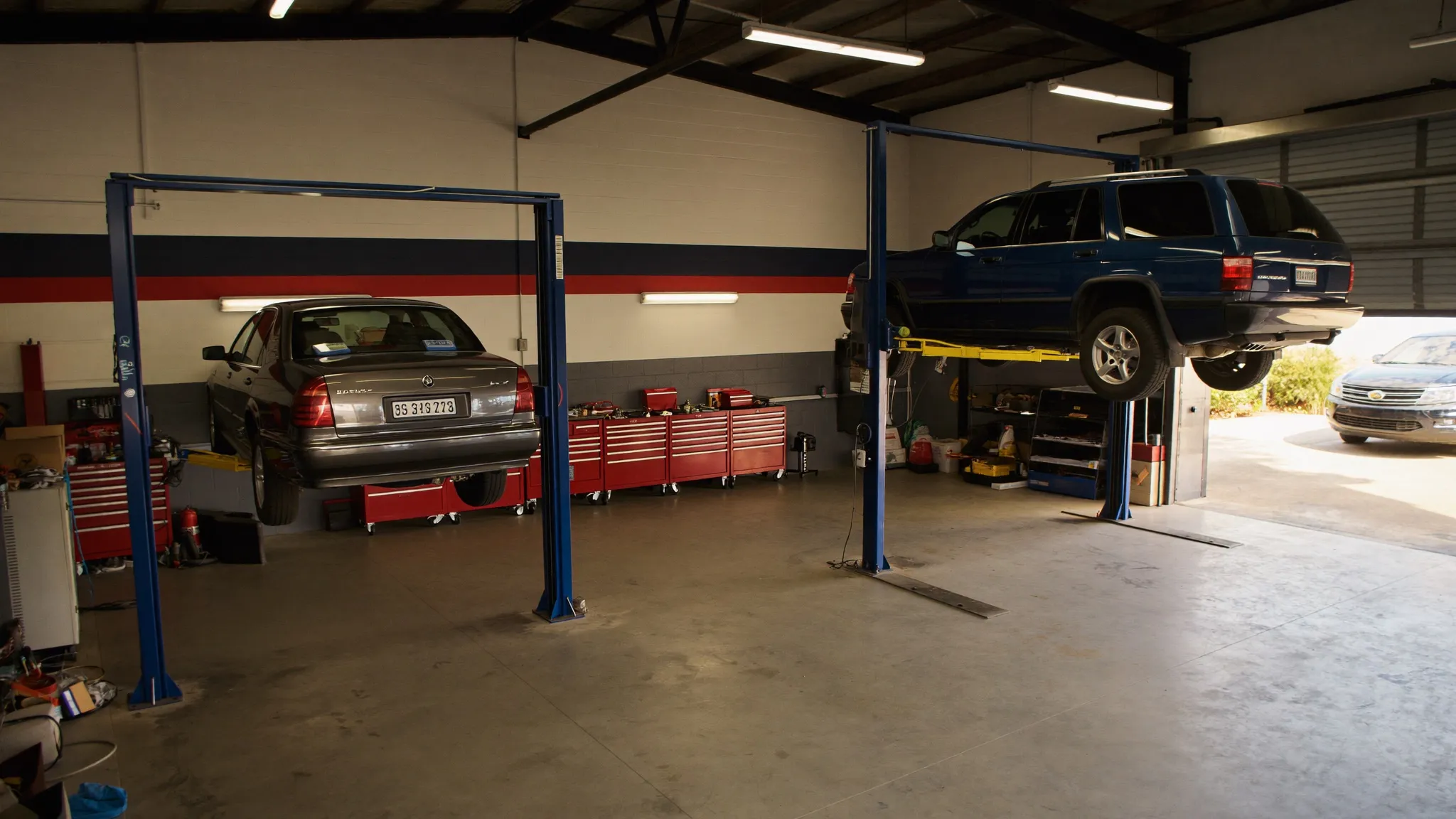
The lift decision is the one most shop owners get wrong on price alone. A two-post 10K-lb lift runs $4,500–$8,500 installed. A four-post drive-on runs $6,500–$13,000 installed. The instinct is to default to the cheaper post and move on. The bay-throughput math says that’s the right call sometimes and the wrong call more often than shop owners admit.
The right question isn’t which lift costs less. It’s which lift, in which bay, fits the work that bay is actually going to do for the next ten years. The financing follows from that, not the other way around.
Two-post: the general-service workhorse
A symmetric or asymmetric two-post 10K-lb lift fits the bulk of general-service work — brake jobs, exhaust, suspension, axles, fluid service, anything that needs the wheels hanging free. The arms swing under the rocker, the vehicle goes up, the technician walks underneath without a deck in the way. On-and-off is fast. Two minutes to set, two minutes to lower, no positioning of wheels into runways.
The capex case is straightforward. $4,500–$8,500 installed gets a name-brand two-post with the certification stack a working shop actually needs — load capacity rated for the vehicle mix coming through the door, ALI/ANSI inspection cadence honored, and the installer’s anchor and concrete-thickness sign-off on file. Cheaper than that and the shop is usually buying out of an unbranded import channel where parts availability and warranty support are the real cost down the road.
What a two-post doesn’t do well: alignments, anything that needs the suspension loaded, drive-on undercarriage inspection, and storage. Alignments specifically need the wheels on a deck with turn plates and slip plates aligned to the rack geometry. A two-post can’t do that work, full stop.
Four-post: alignment, drive-on, and the storage bay
A four-post drive-on at $6,500–$13,000 installed buys a different workflow. The vehicle drives up the ramps, the wheels stay on the runways, and the suspension stays loaded. That’s the right setup for alignment work (with turn plates and slip plates in the runway cutouts), for undercarriage inspections where the suspension geometry needs to match the road condition, and for high-volume lift-and-park work where vehicles cycle on and off without arm-swinging.
The other use case shops underweight: storage. A four-post in a back bay doubles as parking. A car waiting on a part, a customer pickup that didn’t happen Friday afternoon, a project vehicle the owner is working on between paying jobs — the four-post turns one bay’s footprint into two parking spaces. For shops tight on lot, that’s a real number.
What a four-post doesn’t do well: wheels-off service. Brake jobs and tire work want the wheels hanging, which means jacking the vehicle off the runways with a rolling jack — slower than a two-post for that work, and it adds a piece of equipment to buy and store.
The financing math at current rates
Equipment financing in 2026 runs roughly 7–14% depending on credit, term, and lender. The cheaper end of that range is where shop-specialty lenders sit on common lift packages from established manufacturers; the higher end is where general equipment lenders price lift purchases for newer shops or thinner credit files. US prime sits at 6.75% as of December 11, 2025, which anchors the floor.
A worked example, 60-month term, 9.5% APR — a midpoint rate that most established shops with clean books should clear:
- $6,500 two-post installed: $136/month
- $9,750 four-post installed: $205/month
- Monthly delta: $69
That $69/month is the entire financing argument. It’s not nothing — across a 60-month term it’s $4,140 in additional payment — but it’s also less than one alignment per month at current pricing. For shops doing this work through a calculator for shop equipment financing before signing, the gap closes fast under realistic assumptions about bay utilization.
The throughput question is the real one. If the four-post bay is doing two alignments per week — a conservative number for any shop with alignment capability and a tire account — at a $110–$150 ticket and labor-heavy margin, the gross profit on those alignments covers the monthly payment delta inside the first week of every month. Everything after that is bay revenue the two-post couldn’t have produced.
Run it the other way. If the four-post bay isn’t doing alignment or drive-on work — if it’s a general-service bay where the four-post is just a more expensive way to do brake jobs — the $69/month is dead money, and the slower wheels-off workflow costs labor hours on top.
Which lift in which bay: the typical mix
Most multi-bay shops end up running a mix. The shape of the mix tracks shop size more than anything else.
Two-bay shops generally run two two-posts. The capex case for adding a four-post at that scale is hard unless alignment is part of the service menu — and if it is, the four-post is replacing one of the two-posts, not adding a third bay. The shop loses some wheels-off speed and picks up alignment capacity. Whether that’s the right trade depends on the alignment volume the local market will actually deliver.
Three- to four-bay shops usually run two two-posts and one four-post. The four-post bay carries alignment, undercarriage inspection on commercial fleet work, and storage. The two-posts carry the general-service throughput. This is the most common configuration in independent shops doing $1M–$2.5M in annual revenue.
Five-plus bay shops typically add a second four-post once alignment volume justifies it, or once collision/heavy-mechanical work pulls a four-post out of general-service rotation. At that scale the mix often includes a dedicated alignment bay (four-post with rack) and a separate drive-on bay for undercarriage and storage — two four-posts doing different jobs.
The pattern that doesn’t work: four-posts in every bay. The arms-swing speed of a two-post is real, and shops that put four-posts everywhere lose general-service throughput in a way that shows up in flat-rate hours billed per technician per day. Wrong tool for the bay.
Financing structure: what to ask for
Both lift types finance on the same terms structurally — 24- to 84-month equipment loans, with 60 months as the default for a piece of equipment that holds value across a decade-plus. The certification stack and installation cost should be included in the financed amount; splitting installation into a separate cash payment is a common error that leaves shops short of working capital in the month the lift goes in.
For shops financing more than one lift at a time — a new build, a bay expansion, or a full equipment refresh — a single bundled facility from a shop-specialty equipment financing lender usually prices better than separate loans on each piece, and the underwriting reads the lift package as the long-life asset it is rather than as a stack of unrelated equipment.
Section 179 expensing applies to both lift types in year one for shops with the tax appetite to use it. A 25% effective rate moves the after-tax cost of a $9,750 four-post down to roughly $7,300 — which closes the gap with the two-post further than the sticker price suggests.
Bottom line
The lift decision is a bay-workflow decision, not a capex decision. The cheaper post isn’t always the cheaper bay, and the more expensive post isn’t always the right one either. The shops that get this call right do the throughput math before they price the financing: what work is each bay doing, what’s the gross profit on that work, and does the lift in that bay match the workflow.
The financing question answers itself once that’s settled. A 60-month equipment loan at current rates moves a $4,500–$13,000 lift purchase into a monthly payment that nearly any working bay can cover several times over. The risk isn’t the financing. It’s putting the wrong lift in the bay and paying for the mismatch in labor hours and missed revenue for the next decade.