Paint booth ROI in 2026: what booth utilization actually pays a $90K box back
A 2026 mid-tier downdraft paint booth runs $40K-$150K installed. At average insurer-paid panel labor and 60% utilization, the breakeven moves faster than most collision shops assume.
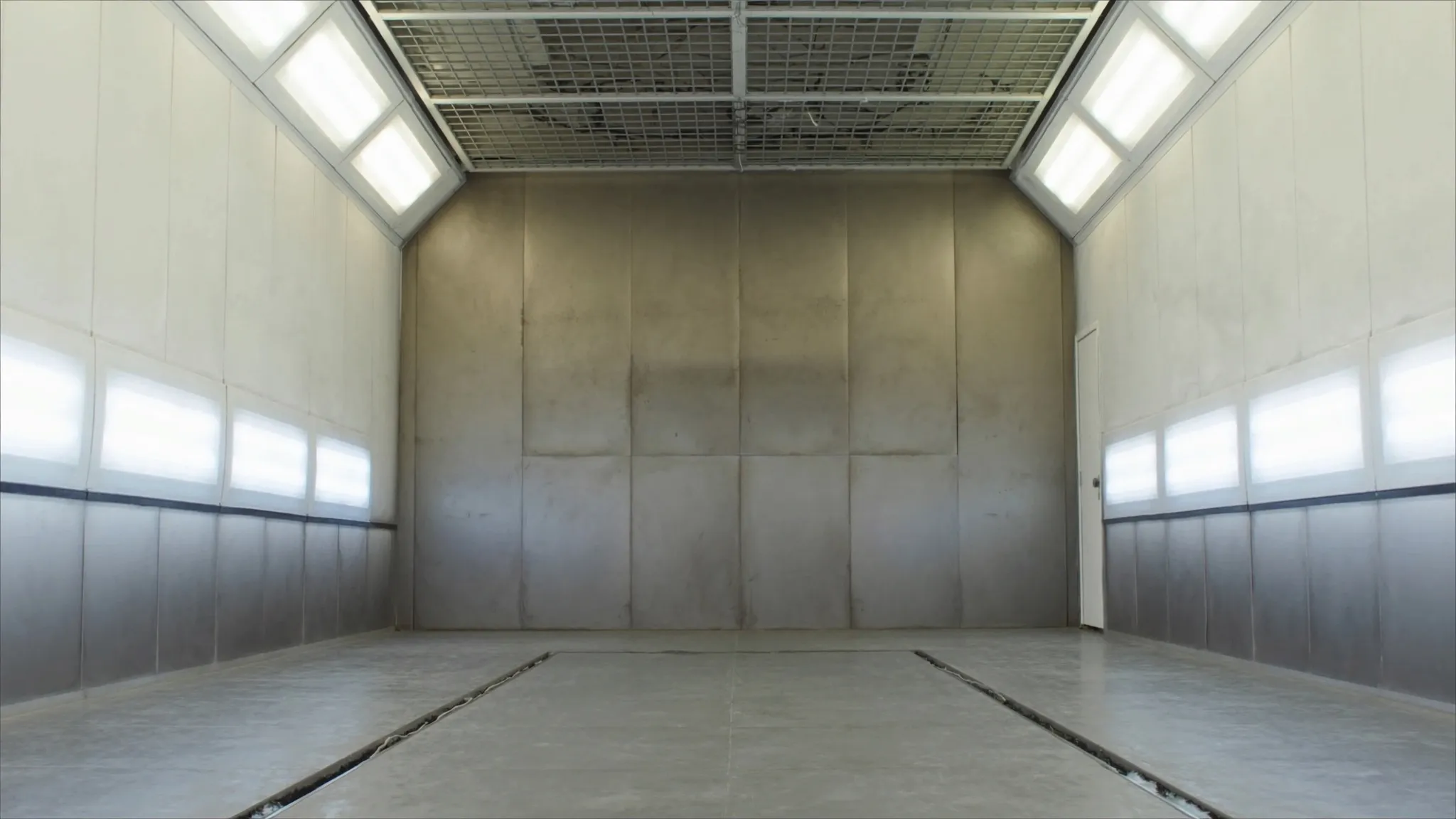
A new paint booth is the single largest equipment line on most collision shop balance sheets, and it is the piece of equipment shop owners argue about the longest before signing. The price range is wide — $40,000 to $150,000 installed in 2026, depending on configuration — and the question is almost never whether the booth pays back. It is whether the bigger booth pays back faster than the smaller one, and at what booth utilization the math actually closes. Most shop owners run that calculation badly. The number that matters is not booth price. It is booth-days per month.
What each configuration costs and what it produces
Three booth tiers cover most of the independent collision market in 2026.
A cross-draft booth — air enters at one end, exits at the other — sits at the bottom of the range. Installed cost runs roughly $40,000 to $60,000. Cycle time is the slowest of the three configurations, finish quality is acceptable for single-stage and most basecoat work, but insurer DRP programs increasingly push shops away from cross-draft for higher-end clearcoat jobs. For a low-volume independent doing mostly mechanical with occasional collision overflow, cross-draft can be the right answer. For a dedicated body shop, it usually is not.
A semi-downdraft booth runs roughly $60,000 to $95,000 installed. Air enters at the ceiling near the front of the booth and exits through the rear floor pit or grates. Cycle time improves meaningfully over cross-draft, and finish quality on metallic and pearl basecoats is significantly better. This is the most common purchase for mid-volume independent collision shops in 2026.
A full downdraft booth — air entering across the entire ceiling, exiting through a full-floor pit — sits at the top of the range, $95,000 to $150,000 installed depending on size, heater capacity, and whether the shop has the pit infrastructure or has to cut and pour. Cycle time is the fastest of the three, finish quality is what high-end DRP programs and OEM-certified collision work expect, and throughput on multi-panel jobs is materially better than either of the other two configurations. The premium over semi-downdraft is real. Whether it pays back depends entirely on volume.
Revenue per booth-day
The revenue side of the math is where most shop owners over- or under-estimate. The mechanics are straightforward.
A typical 4-panel collision job — front fender, door, quarter, and bumper, with blends into adjacent panels — produces somewhere in the range of 18 to 26 refinish hours on a standard insurer estimate, depending on the carrier and the panel mix. At a refinish labor rate that in most US metros now sits between $58 and $72 per hour for door-rate insurer pay, that is roughly $1,100 to $1,800 in labor revenue per job. Materials are billed separately, typically at a rate that produces $35 to $55 per refinish hour in paint and materials gross margin after product cost.
Combine the two: a 4-panel job produces somewhere between $1,700 and $2,700 in combined refinish labor and materials margin. A productive booth-day in a mid-volume shop runs one job of that size through prep, paint, and bake, or two smaller 1-2 panel jobs. Call the booth-day revenue at around $1,800 to $2,400 in combined labor and materials margin on average.
At 60% utilization — booth occupied 60% of working days, which is a realistic target for a shop with a steady DRP relationship and is below what dedicated high-volume body shops actually achieve — a booth produces roughly 13 productive booth-days per month. That is $23,000 to $31,000 in monthly combined refinish revenue. The booth payment has to come out of that.
Cycle time math
The cycle-time piece is what separates the three booth tiers and what most shop owners under-weight.
A 4-panel job has roughly three booth-relevant phases: prep and masking (most of which can happen outside the booth in a dedicated prep station, but a portion typically occurs inside), spray application, and bake or flash cycles. Total booth occupancy on a 4-panel job runs roughly 3 to 5 hours in a cross-draft booth, 2.5 to 4 hours in a semi-downdraft, and 2 to 3 hours in a full downdraft with an infrared accelerated cure system.
That gap matters. A cross-draft booth that occupies 4.5 hours per job caps out at one big job plus a touch-up per booth-day. A downdraft with accelerated cure that runs the same job in 2.5 hours can fit two big jobs in the same day. On a high-volume DRP shop, that throughput difference is the entire ROI argument for the bigger booth. On a low-volume independent, it does not matter because the booth sits empty most of the day either way.
The breakeven on a $90K booth
A $90,000 semi-downdraft booth financed over 84 months at 11% — a reasonable mid-2026 equipment rate for a collision shop with mixed credit, given the US prime rate sits at 6.75% as of December 11, 2025 and equipment financing for credit-clean shops typically runs in the 7–14% range depending on credit profile — produces a monthly payment of roughly $1,540. Lenders that underwrite collision equipment specifically tend to land toward the lower end of that range; on collision-equipment financing the booth and the frame machine are the two assets most likely to get good rates because both hold collateral value across the loan term. Shops comparing offers should run quotes through a monthly payment calculator for shop equipment financing before signing — moving the term from 60 to 84 months on a $90K booth changes the monthly nut by roughly $500, which is the difference between a payment that disappears into a single booth-day and one that does not.
Against $23,000 to $31,000 in monthly refinish margin at 60% utilization, a $1,540 booth payment is roughly one booth-day per month. That is the headline number. Everything above one booth-day of margin contributes to overhead, technician compensation, and net.
The risk to that math is not the payment. It is the utilization assumption. A shop running 30% booth utilization — booth busy 6 to 7 days a month instead of 13 — produces roughly $11,000 to $15,000 in monthly refinish margin. The booth payment is still covered, but the margin available for everything else compresses materially. The shops that get into trouble on booth financing are almost always shops that bought booth capacity ahead of demand and never built the DRP relationships to fill it.
When the bigger booth wins
Three scenarios where full downdraft over semi-downdraft pays back inside the financing term.
Multi-carrier DRP shops with cycle-time benchmarks. If insurer scorecards measure your shop on key-to-key cycle days, and refinish bake time is the bottleneck on those measurements, the throughput delta from a full downdraft with accelerated cure shows up directly in DRP work volume.
Fleet repaint and commercial work. Repainting a delivery van or service truck is one large multi-panel job that benefits enormously from the larger booth footprint and faster cycle time. Shops with a steady fleet repaint book outgrow semi-downdraft fast.
Multi-color production runs. Shops doing aftermarket color changes, restoration work, or specialty refinish at volume need the larger booth and the better airflow to hit finish quality at speed.
When the smaller booth wins
Two scenarios where cross-draft or basic semi-downdraft is the correct answer.
Low-volume independents where collision is overflow. A general mechanical shop that picks up 4 to 8 collision jobs a month does not need full downdraft capacity. Cross-draft at $50,000 financed over 60 months produces a payment in the $1,050 range — coverable on 4-5 jobs of margin per month with room to spare.
Cash-constrained shops that want to enter collision without a $150K capex commit. A semi-downdraft at the lower end of the price range gets a shop into DRP-acceptable refinish work at roughly 60% of the full-downdraft capex. Shops that do this and then outgrow it inside three years are doing the math correctly — proving the demand exists before sizing up. Shops looking at this specifically should price collision-specific equipment financing programs against generic equipment lenders, because the underwriting reads differently on insurer relationships and equipment collateral value.
Bottom line
A $90,000 paint booth at 60% utilization and average insurer-paid refinish labor pays its monthly nut with roughly one booth-day per month of margin. The risk is not the booth. It is the assumption that 60% utilization materializes. Shops adding booth capacity for the first time should size to current demand plus a conservative growth assumption, not to the demand a new booth is supposed to generate. The shops that get booth financing wrong almost always overbought capacity. The shops that get it right matched configuration to actual booked work and let the next-tier booth wait until the current one was full.