Lease vs buy on shop equipment in 2026: the decision framework that actually works
On a five-year horizon, a leased $40K alignment rack costs roughly 28% more than a financed one — but cash flow, tax treatment, and equipment lifecycle change the answer for some shops.
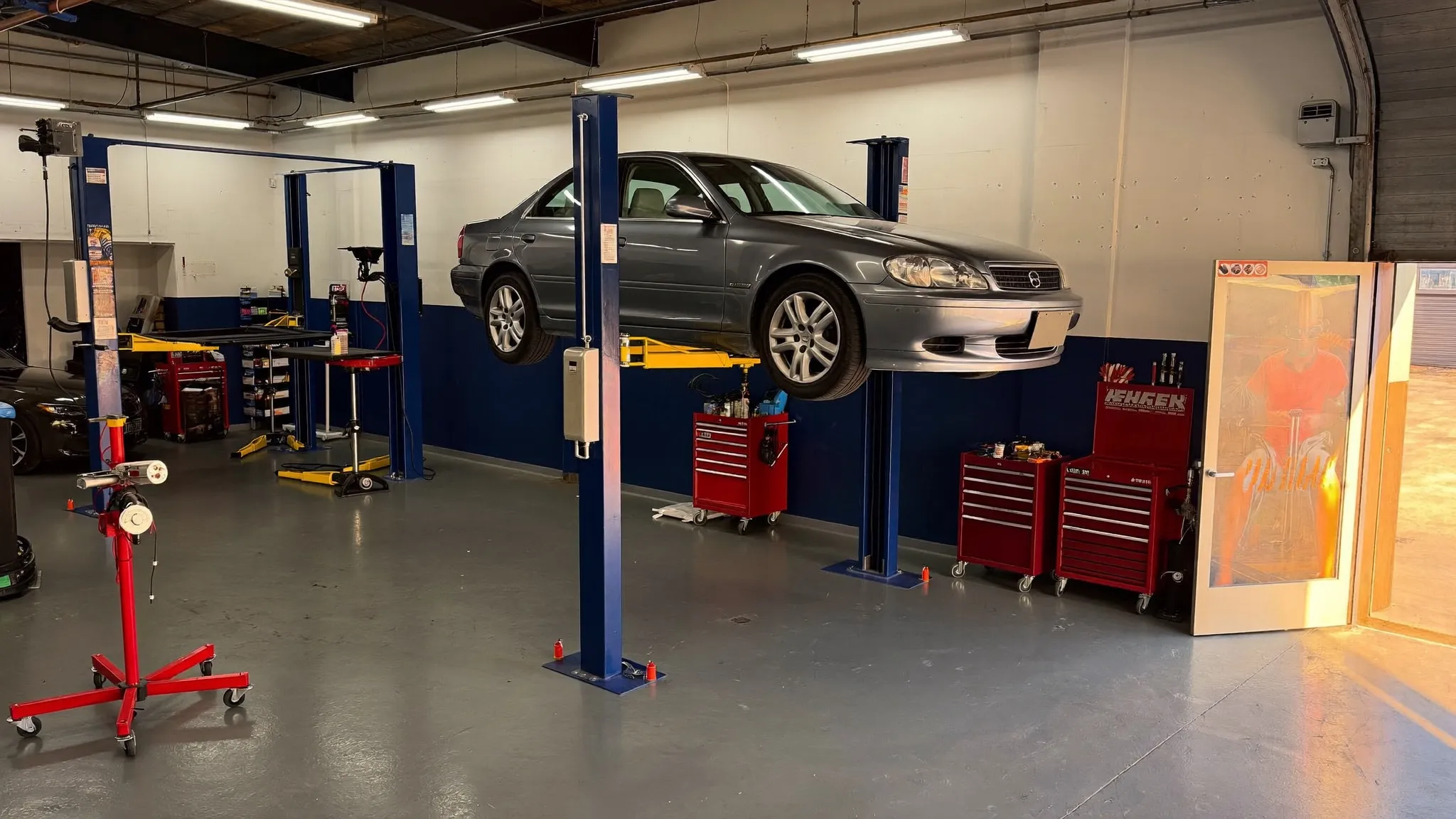
Start with the money. A $40,000 alignment rack, financed over 60 months at the low end of equipment financing pricing — call it 9% — pencils out at roughly $830 a month. Total paid: about $49,800. At the end of the term, the rack is yours, fully depreciated on your books, and a working asset for whatever its remaining service life is — typically another five to ten years on a quality rack with normal use.
The same rack on a 60-month operating lease, structured to a $1 buyout, runs in the same neighborhood — that’s a capital lease in everything but name, and the rates track. The version most shops actually consider is an FMV (fair market value) lease, which trades a lower monthly payment against no automatic ownership at end of term. On an FMV lease, the same $40K rack often comes in at $700–$750 a month — call it $725 — for a total of $43,500 over the term, plus the FMV buyout if you want to keep it. End-of-term FMV on a five-year-old alignment rack typically lands at 10–20% of original cost, so figure another $4,000–$8,000 to own it outright.
Run both scenarios to the same endpoint — owning the rack at year five — and the lease costs roughly $47,500–$51,500 against the loan’s $49,800. The numbers can come out within a thousand dollars of each other. The reason most shop owners default to “buying is cheaper” is that they’re comparing a true FMV lease (lower payment, no ownership) against a loan (higher payment, ownership). That’s not the same product on both sides of the comparison.
The real lease-vs-buy decision is rarely about which is cheaper on a five-year total-cost line. It’s about cash flow, tax treatment, balance-sheet position, and how long the asset will actually be useful in your shop. The right answer is asset-specific, and most shops in 2026 are running both products simultaneously.
The payment math, honestly
Three numbers matter on any equipment financing decision. The monthly payment, the total paid over the term, and what you own at the end. Most shop owners look hard at the first one and barely glance at the other two.
Equipment financing in 2026 is pricing in the 7–14% range, with the better end of that band going to shops with strong credit and clean books on assets the lender can easily resell. A $40,000 financed purchase at 9% over 60 months is about $830 per month. At 12% — closer to where weaker-credit shops or harder-to-resell equipment prices — it’s about $890. Push the term out to 72 months at 9% and the monthly drops to about $720, but total paid climbs to $51,800. Term length matters more than most shop owners model when they sign.
Leases price into a similar range on the underlying capital cost, but the lessor captures the depreciation and the residual value, which is why the monthly payment lands lower. The trade is real: lower nut, no ownership unless you buy out. On a structured equipment lease for shop assets, the rate is often quoted as a money factor or a monthly payment rather than an APR, which can make direct comparison against a loan harder. Convert it to a total-paid number across the full term plus any buyout, and compare against the loan’s total paid plus residual asset value. That’s the apples-to-apples view.
Before signing on either side, run the actual numbers through a monthly payment calculator built for shop equipment. The gap between a 48- and a 60-month term on a $45,000 equipment package moves the monthly payment by more than most shop owners expect — and the difference compounds when you’re stacking three or four pieces of equipment across a year.
Tax treatment is where the answer actually shifts
The depreciation question is the second axis of the decision, and it’s where the calculation breaks open beyond pure payment math.
A financed equipment purchase puts the asset on your balance sheet. You own it; you depreciate it. Under current Section 179 expensing rules, qualifying equipment can be expensed in the year placed in service rather than depreciated over the asset’s class life, which can move a meaningful chunk of the purchase price into a current-year deduction. The exact dollar limits and phase-out thresholds adjust by tax year, so confirm the current-year caps with your tax preparer before you sign — but the structural point holds: a financed purchase generates a depreciation deduction the shop captures.
A true FMV lease (one structured as a tax lease, not a capital lease) doesn’t put the asset on your balance sheet. The lessor owns the equipment for tax purposes, the lessor takes the depreciation, and the shop deducts the monthly lease payment as an operating expense. That’s a different and often less front-loaded deduction than Section 179 on a financed purchase.
Two practical takeaways from that structural difference. First: if your shop is in a profitable year and Section 179 would meaningfully reduce taxable income, the financed purchase often wins on after-tax cost — sometimes by enough to flip an otherwise lease-favored decision. Second: if your shop is in a thin year, or operating at a loss, the Section 179 advantage on a financed purchase is muted or zero — and the lease’s lower monthly payment and operating-expense deduction often pencils better.
The shop owner who runs the same lease-vs-buy comparison two years in a row will sometimes get different answers, because the tax position changed. That’s normal. It’s also why the decision is worth running with your accountant in the loop on any single purchase above roughly $25,000.
When leasing wins
Three situations where leasing reliably beats financing on the actual operating math.
Fast-turnover diagnostic and software-heavy equipment. Scan tools, ADAS calibration platforms, and OEM-specific diagnostic systems are aging out on three-to-four-year cycles in 2026, not five-to-eight. The scan tool that’s current today is missing coverage for the next two model years of EV high-voltage architecture and the latest ADAS feature sets. Buying that equipment locks the shop into a depreciating asset on a depreciation schedule longer than the equipment’s useful life. Leasing matches the financing term to the actual service life, hands the obsolescence risk to the lessor, and rolls into the next generation cleanly at end of term.
Cash-tight shops protecting working capital. A $700 lease payment versus an $830 loan payment is $130 a month — $1,560 a year. That sounds trivial against a $40,000 asset, but stack it across three or four equipment items in a working capital crunch, and you’re protecting $5,000–$8,000 a year in operating cash. For a shop running tight, that’s the difference between covering payroll on a slow week and reaching for the working capital line at 12–22% APR.
Shops in low-tax-bracket years. If Section 179 isn’t generating meaningful tax savings — because the shop’s net income is low or it’s in a loss year — the depreciation advantage of buying largely disappears. At that point, the lease’s lower monthly payment and operating-expense deduction often comes out ahead on after-tax cost.
When buying wins
The mirror image. Three situations where financing-and-owning reliably beats leasing.
Long-life capital equipment. Four-post lifts, two-post lifts, alignment racks, paint booths, frame machines, brake lathes — assets with 10-to-20-year service lives. Leasing one of these is paying lease premium on an asset that will still be working in your shop a decade after the lease term ends. Own it, depreciate it, and the asset continues earning revenue against zero remaining financing cost.
Profitable shops with Section 179 headroom. When the shop has strong net income and the equipment purchase falls inside current Section 179 expensing limits, the front-loaded deduction can shift the after-tax math meaningfully toward buying. For a shop in a healthy tax position, the depreciation advantage on a $40,000 lift package can be worth several thousand dollars of after-tax cash compared to leasing the same equipment.
Shops with strong cash position and no working-capital pressure. The lower-payment argument for leasing matters most when cash is tight. For a shop sitting on cash reserves, the lower lease payment is less valuable than the long-term ownership of the asset.
The hybrid play most 2026 shops are running
The framing as “lease or buy” misses how most independent shops are actually structuring their 2026 capex. The dominant pattern is hybrid: lease the fast-turnover side, finance and own the long-life side, and let each product do the work it’s built for.
A representative mid-sized general repair shop running this approach in 2026 might have a financed two-post lift package and a financed alignment rack on five-to-seven-year terms (long-life assets, on the balance sheet, depreciated and owned), an FMV-leased ADAS calibration system and an FMV-leased multi-brand scan tool platform (fast-turnover diagnostic gear that will be replaced at end of term), and a small working-capital line covering payroll timing and parts inventory between commercial fleet payment cycles.
That stack matches each financial product to the operational profile of the asset it’s funding. The lifts and alignment rack are still earning revenue at year ten; the scan tool and ADAS system have been rolled into the next generation at year four. Neither product is being asked to fund an asset class it doesn’t fit.
The shops still defaulting to one product for everything — either financing every piece of equipment regardless of its service life, or leasing everything regardless of long-term cost — are leaving real money on the table. Not catastrophic money. But across a five-year capex cycle on a shop running $1.5M–$3M in annual revenue, the difference between matched financing and one-size-fits-all financing routinely runs $15,000–$30,000 in after-tax cost.
The bottom line
Lease versus buy on shop equipment in 2026 isn’t a single answer. It’s a per-asset decision driven by the asset’s useful life relative to the financing term, the shop’s current tax position, and how much cash flow headroom the monthly payment difference actually buys. Long-life equipment — lifts, alignment racks, paint booths, frame machines — almost always favors financing and owning. Fast-turnover diagnostic equipment with a three-to-four-year useful life almost always favors leasing. The middle ground — A/C machines, brake lathes, tire equipment with five-to-eight-year service lives — is where the shop’s tax position and cash flow situation drive the answer. Run the math on each asset individually, with your accountant in the loop on anything above $25,000, and the right answer surfaces for that purchase in that year. That’s the framework that actually works.