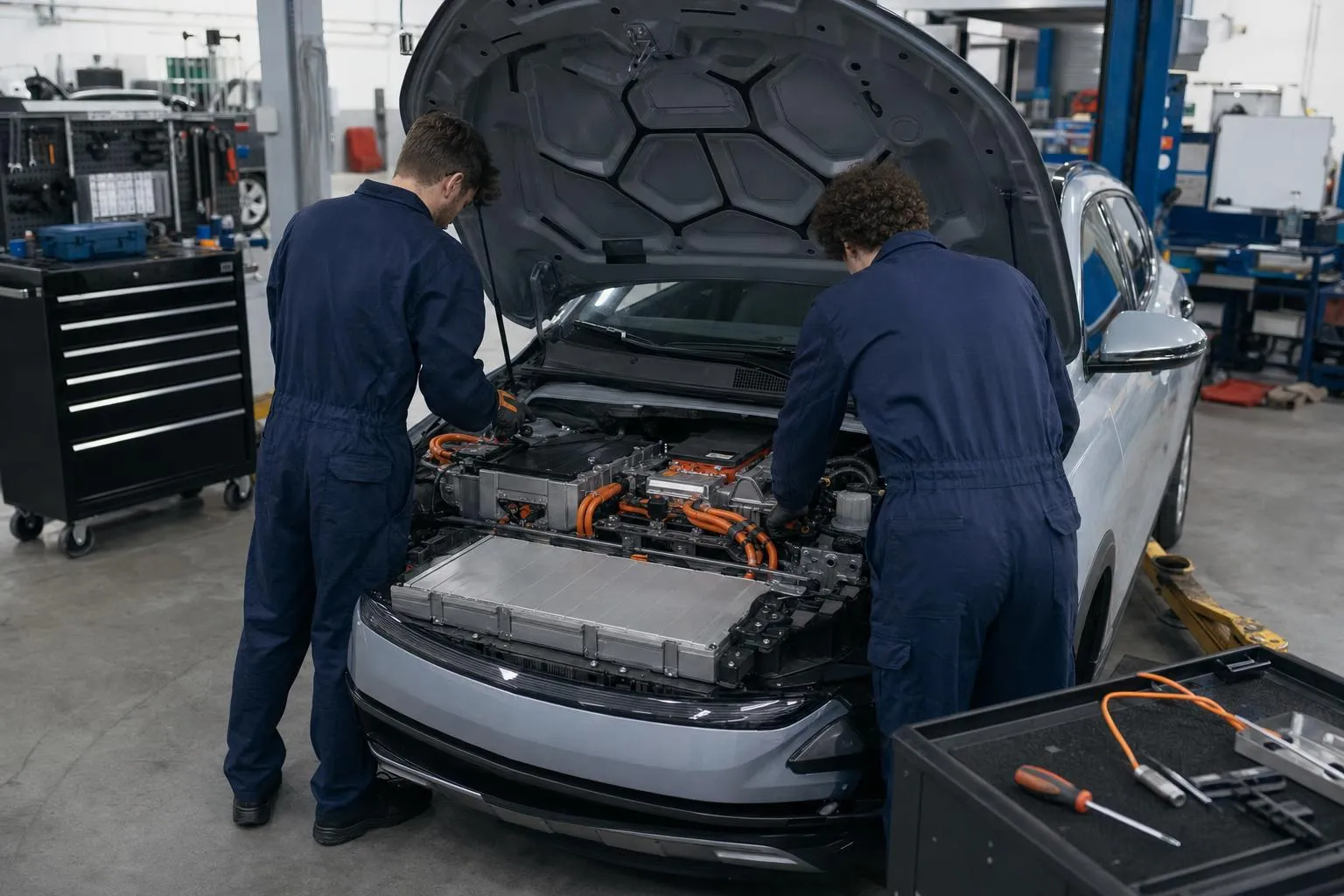
EV training is the single biggest investment shop owners are making in 2026
Survey of 412 independent shops: 68% are sending at least one tech to certification this year.
Independent repair shops have spent years watching the EV transition from a distance. That distance is closing fast. In a survey of 412 independent shops conducted by Mechanics.news in October 2025, 68% said they are sending at least one technician to an EV or hybrid certification program this year. A year ago, that figure was 41%.
The shift is not ideological. It is driven by car counts. EVs and plug-in hybrids now account for roughly 9% of new-vehicle sales nationally, and the fleet of registered battery-electric and plug-in hybrid vehicles has grown to 4.8 million units — vehicles that need service, eventually show up in driveways, and end up at whoever the owner trusts with their car.
Why 2026 is the inflection year
The service profile of EVs is different from ICE vehicles, but it is not as sparse as dealers implied during the sales boom. Tire wear runs higher on heavy BEVs. Brake fluid, cabin air filters, and coolant service are real intervals. Battery and high-voltage system inspections are coming due on early-adopter vehicles that are now 5–7 years old.
More to the point, hybrid vehicles — which require both traditional engine service and some high-voltage competence — are a much larger chunk of the market than full BEVs. A shop that can handle a 2021 RAV4 Prime’s transmission service or a Prius brake-actuator calibration is already in the EV business; many shop owners haven’t framed it that way.
Shops that wait for EVs to “really take over” before training will be 3–4 years behind. The hybrid wave is already here.
What training actually costs — and what it returns
ASE has L3 (Light Duty Hybrid/Electric Vehicle) and L4 (Advanced Driver Assistance Systems) certifications. The full L3 prep, exam, and recertification cycle runs $800–$1,200 per tech, depending on prep materials used. OEM-specific programs (GM ASEP EV, Toyota T-TEN) cost more and take longer but open OEM warranty work.
Among shops in the survey that had completed EV training:
- 72% reported accepting at least one high-voltage service job in the following six months that they previously declined
- Median additional monthly revenue from EV-related work: $2,400
- Average time to recoup training cost per tech: 4.1 months
Those numbers are specific to shops that actively marketed the capability. Shops that trained but didn’t update their Google Business Profile or mention EV service on their website reported much flatter results.
How shops are covering the cost
The most common approach is splitting the cost 50/50 between the shop and the technician, with the shop’s half treated as a deductible professional development expense. Roughly 23% of respondents are paying the full cost and requiring a 24-month stay commitment in writing.
Several state workforce development programs are also co-funding EV training for shops in manufacturing and rural corridors. California’s EV Technician Training Program, New York’s Green Jobs-Green New York initiative, and Illinois’s Fast Track programs were the three most frequently cited by survey respondents.
What to watch next
The next constraint is not willingness to train — it is trainer capacity. The top-rated EV certification programs have waitlists of 8–16 weeks. Shops planning 2026 training should be booking programs now.
NAPA AutoCare and RepairLink have both added EV training as a membership benefit in 2025. Shops already on those networks should check what is included before paying out of pocket for third-party programs.