The 2026 auto repair shop financing map: what equipment, vehicle, and shop-specialty loans actually cost
What equipment financing, leasing, vehicle loans, and shop-specialty lenders actually cost auto repair shop owners in 2026 — and when generic SBA still wins.
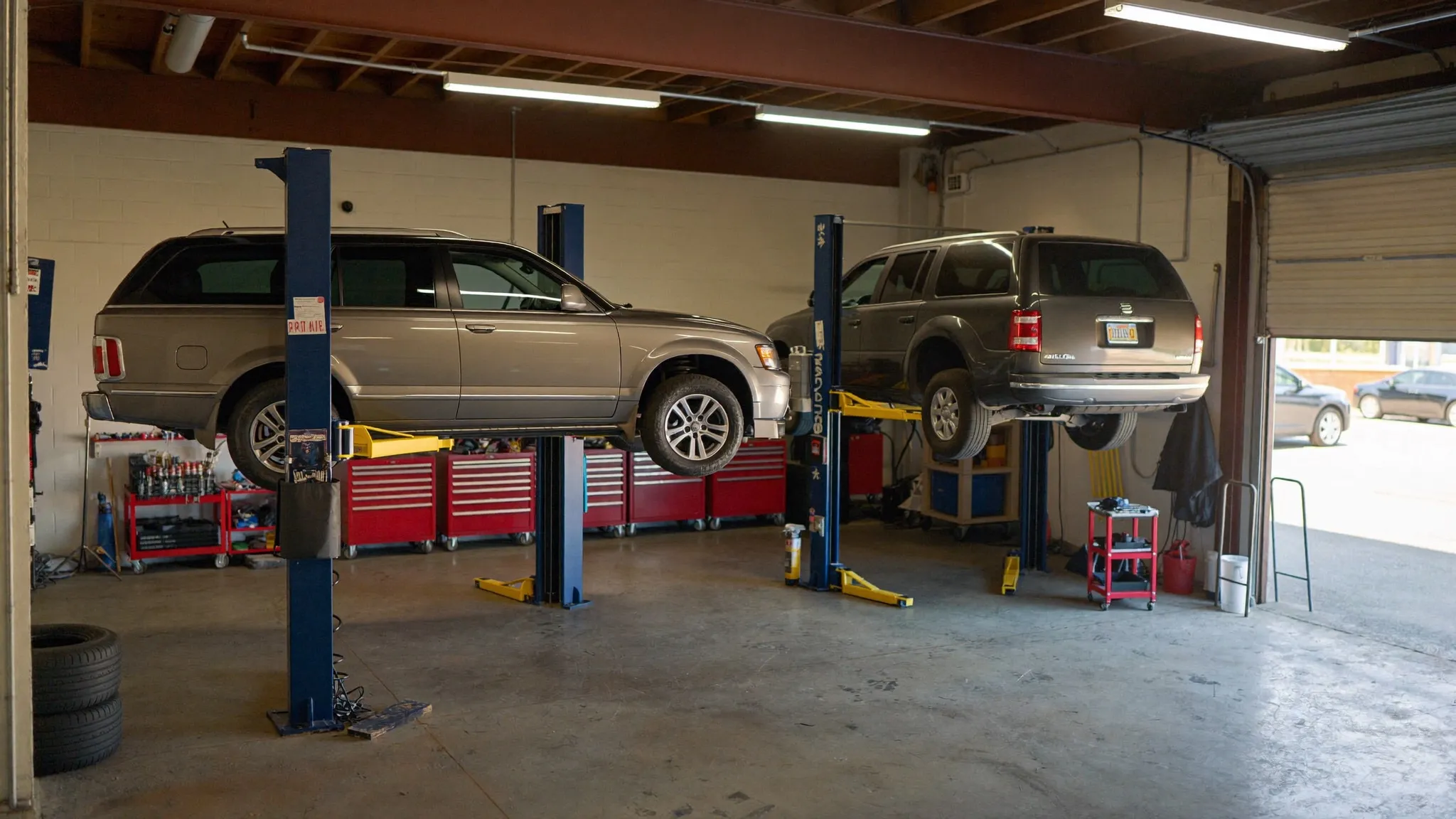
The squeeze on independent auto repair shops in 2026 is not one big thing — it’s a pile of small ones. Parts pricing has settled higher than 2024 levels and stayed there. Technician wages have moved up another tier in competitive metros, with A-tech compensation in major markets now routinely clearing $35/hr in base pay before flat-rate multipliers. The capex menu has expanded: ADAS calibration targets, EV high-voltage diagnostic tooling, A2L-compliant A/C service equipment, and software subscriptions that didn’t exist on a 2021 budget. Customer pay timing on commercial fleet accounts has stretched. None of it is catastrophic on its own. The cumulative effect is that shop owners who used to fund growth out of operating cash are reaching for outside capital more often than they were three years ago.
This is a map of what the financing menu looks like for an auto repair shop in 2026 — what each option costs, when each fits, and where shop-specialty lenders are outperforming the generic small-business defaults.
Why generic lending fails auto repair shops
Most small-business credit products are built around a baseline that doesn’t describe an auto shop. Generic underwriting models look for steady monthly recurring revenue, low fixed-asset intensity, and balance-sheet growth that walks a smooth line. Auto repair reads differently on the page. Revenue is lumpy by season — A/C work compresses into a six-week window, tire and alignment volume spikes in spring and fall, collision work moves with weather events. Equipment isn’t a side cost; for most shops it’s the largest line on the balance sheet after the building. Parts pass-through inflates top-line revenue without contributing margin, which makes generic revenue multiples misleading. And technician headcount drives capacity in a way that doesn’t show up cleanly in a P&L.
Generic underwriters flatten all of that into “irregular cash flow, asset-heavy, high payroll intensity” and either price the risk aggressively or decline. That’s why a category of shop-specialty equipment financing programs has emerged: products that read seasonal swings as a revenue pattern rather than a warning, that underwrite against equipment value the way an asset lender would, and that close in days. The mechanics of underwriting are the same. The assumptions are different.
The four financing types auto shops actually use in 2026
Most independent shops end up using a combination of four products. Each solves a different cash-flow problem.
Equipment financing
Lifts, alignment racks, scan tools, ADAS calibration targets, A/C machines, brake lathes, tire changers — anything titled or with a serial number can usually be financed on terms of 24 to 84 months, with rates in roughly the 7–14% range as of mid-2026. Equipment lenders underwrite the asset itself, which is why approvals are often quick even for newer shops. The bigger purchases — a new four-post lift package, a full ADAS calibration system, a paint booth — frequently land in the $25K–$80K range, where loan-level financing makes more sense than putting capex on a working capital line. Before signing anything, run the real numbers through a monthly payment calculator: the gap between a 48- and 60-month term on a $45,000 equipment package moves the monthly nut by more than most shop owners expect when they sign.
Equipment leasing
Leasing is the second option on the same equipment, and it’s structurally different in three ways: lower monthly payments, no ownership at end of term unless you exercise a buyout, and the lessor — not the shop — captures the depreciation benefit. For shops that turn equipment over fast (scan tools, software-heavy diagnostic platforms that age out in 3–4 years), a structured equipment lease often beats a loan on cash flow even though it costs more on a 5-year basis. For lifts and alignment racks that hold value across a decade, the loan-and-own path almost always wins long-term. The split between the two products is mostly a question of how long the asset stays useful in your shop.
Vehicle financing
Mobile mechanic vans, parts vans, fleet service vehicles, and tow trucks are their own category. The collateral is a titled vehicle, which means rates are typically a notch lower than general equipment financing — running roughly 6.5–11% in mid-2026 for new units, depending on credit and term. Used vehicles price higher and term shorter. Shops adding mobile service capability, expanding parts logistics, or fielding a second tow truck should price the financing separately from general equipment: van-specific financing programs underwrite the asset and the operating use case differently than a generic equipment lender will. The bigger error most shops make is bundling the van into a working capital line — which costs meaningfully more over the life of the asset.
Working capital and SBA
Working capital lines fund the gap between paying techs on Friday and getting paid on commercial fleet accounts 30–60 days later. Trade-focused working capital lines in 2026 run roughly in the 12–22% APR range, with approvals in days and minimal paperwork. SBA 7(a) and 504 remain the structurally cheapest capital in the market — 7(a) typically priced in the prime-plus-2.75 to prime-plus-4.75 range, 504 lower for real estate — but the timeline has stretched. Approval-to-funding on 7(a) is currently running well past 60 days in many cases. If you have an equipment order on the calendar or payroll in three weeks, SBA isn’t the right product for that specific need.
A pragmatic frame: SBA for long-horizon, low-cost capital. Specialty equipment, lease, and vehicle products for the speed-sensitive work in between.
Sub-vertical: where shop type changes the financing answer
The pattern shifts depending on what kind of shop you run. The equipment mix is different, the underwriting reads different, and the specialist lender that fits is different.
General repair and service
The capex stack is the broadest: lifts, alignment, scan tools and software subscriptions, A/C machines (now stepping up to A2L-compliant units), brake lathes, and increasingly EV-capable diagnostic equipment. The 2026 wrinkle is the speed at which the diagnostic side is aging out — scan tools that were current in 2022 are missing coverage for current-model-year ADAS, EV high-voltage systems, and the latest OEM telematics. Most general repair shops are running a mixed strategy: financing the long-life equipment (lifts, alignment) and leasing or short-term financing the diagnostic and software-heavy side that turns over faster. Shop-specialty lenders read the mix correctly. Generic equipment lenders frequently don’t.
Collision and body
Collision is the heaviest capex sub-vertical in auto repair. Frame machines run $30K–$80K. Spray booths run $40K–$150K depending on size and downdraft configuration. ADAS calibration setups — increasingly required as a line item on most modern collision jobs — run anywhere from $25K to well past $200K for a full multi-OEM target system. On top of that, insurer-driven cycle-time pressure means body shops can’t afford equipment downtime, which pushes toward newer units and shorter replacement cycles. Collision-specific financing underwrites against insurer DRP relationships and the specific equipment economics — booth utilization, ADAS calibration revenue per claim, frame machine throughput — that generic lenders don’t model. The result is meaningfully better approval rates on the larger booth and frame purchases.
Tire and wheel
Tire shops have a different equipment profile and a different cash-flow shape. The core equipment — high-volume tire changers, road force balancers, alignment systems, TPMS tooling — is less expensive per-unit than collision equipment but turns over more often as wheel sizes, run-flat construction, and EV-specific tire specifications evolve. Inventory financing also matters more for tire shops than for general repair, since tire stock is a real working capital draw. Tire shop financing programs bundle equipment financing with inventory facilities in ways that fit how tire shops actually operate. Generic lenders treat the inventory side as a separate (and harder) underwrite.
When generic still wins
This isn’t an argument against conventional lending. Three situations where a traditional bank line or an SBA product is unambiguously the right answer:
Real estate purchase. If you’re buying the building you operate out of, SBA 504 is the cheapest capital in the market. The timeline is long; the rate and term make it worth waiting.
Long-tenure, clean-books shops. Five or more years of consistent revenue, strong balance sheet, and time to walk a community bank through your story — a traditional bank line will undercut every specialist product on price. Specialists win on speed and approval odds, not on rate.
Multi-bay expansion or acquisition above $1.5M. Most shop-specialty lenders cap somewhere between $250K and $1.5M on a single facility. Above that, you’re back in conventional bank or SBA territory regardless of how shop-fluent the lender is.
Reasonable shop owners use both. The mistake is assuming the conventional product is the right answer for every need, when in 2026 it’s often the right answer for only some of them.
Before you apply: the shop owner decision checklist
Before approaching any lender — specialty or conventional — have the following ready. The difference between a one-week approval and a six-week approval is almost always how clean the package is on day one.
- Three months of bank statements — all operating accounts, not selected ones.
- Aged accounts receivable report — pulled the day of application, particularly if you have commercial fleet or insurer DRP work.
- Equipment quote or invoice — if the financing is for a specific asset, the lender wants the exact spec and price.
- Two years of business tax returns — and a current-year P&L if you’re more than six months into the year.
- Shop license, EPA compliance documentation, and insurance certificates — current, in the operating state, with no lapses in file.
That’s it. Anything more sophisticated comes from the underwriter, not the applicant.
The bottom line
The shop owners funding 2026 well aren’t doing anything exotic. They’ve stopped treating SBA as the default and started matching the product to the need: equipment loans for the long-life assets, equipment leases for the fast-turnover diagnostic side, vehicle financing for the vans and tow trucks, working capital for the receivables gap, and SBA for the building and the long-horizon plays. Before any of it, run the actual payment through a calculator. A booth or a lift package looks different on paper than it does on a monthly nut, and most signing regret is just math that didn’t get done in advance.